
Subtext
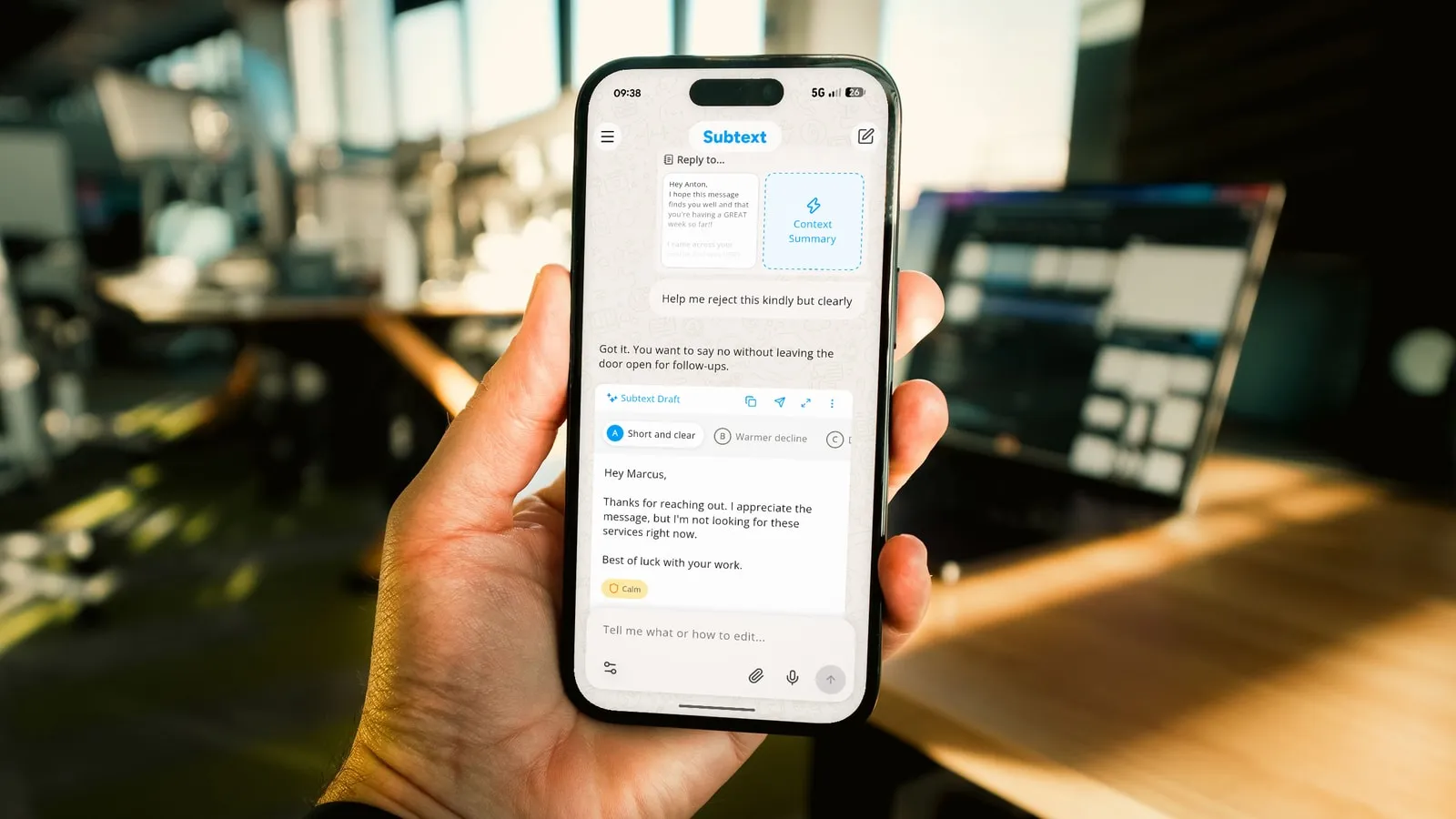
You can tell when a message came from a robot. So can the person reading yours. Subtext is an AI writing assistant and tone checker for personal messages. It reads how a draft comes across before it’s sent, then helps you say the same thing clearly, warmly and in your own voice.
A written message loses most of what carries tone in a conversation. There is no facial expression, no voice, no pause before the reply. The words have to do all of that work, and they do it less well than the writer assumes. In a series of five experiments, people who sent emails were confident their readers would catch the intended tone, serious or sarcastic. Readers got it right far less often than the writers expected1. When you reread your own message, you hear the tone you meant. The reader only sees the words.
Emotions are even harder to get across. In one study, people wrote text messages meant to express one of 22 different feelings, without naming the feeling. Readers identified the right one about one time in five2. Naming what we feel is hard even for ourselves. Brené Brown’s team asked 7,000 people to name their emotions as they experienced them. Most could name three: happy, sad and angry3. A difficult message usually carries more than that.
Putting a feeling into words does something useful. People who can tell their emotions apart in fine detail cope with them better4, and labelling an emotion measurably calms the brain’s alarm response5. This is why Subtext reads before it writes. It marks the exact words in a draft that could come across as harsh, passive or over-apologetic, names the feeling behind them, and only then suggests versions. The versions keep your phrasing and your rhythm. They should sound like you on a clearer day, not like a template.
Rewriting is the easy part. Every phone now has a button that makes a message friendlier or more professional, and the result is polite in exactly the same way for everyone. There is also a deeper problem with asking a general AI assistant how your message sounds. Models trained on human approval learn to agree with you rather than level with you6, a tendency strong enough that OpenAI withdrew a model update because of it7. An editor for feelings has to be willing to tell you that your apology reads like a defence. Subtext’s analysis step is deliberately unflattering for that reason. Nobody needs their words replaced. What helps, in the moment before sending, is knowing that the message reads colder than you feel.
Subtext is made by two people in Berlin. It runs on iPhone, iPad, Android and the web, in 17+ languages, and nothing you send is used to train a model.
Use Subtext
Write your message. We read the tone. Like a therapist for messages, we’ll spot emotions and triggers.
Sources
- Kruger, Epley, Parker & Ng (2005), “Egocentrism over e-mail: Can we communicate as well as we think?”, Journal of Personality and Social Psychology 89(6)
- Holtgraves (2022), Computers in Human Behavior Reports 7, as listed on the research page of subtext.it
- Belinda Luscombe, “Brené Brown Thinks You Should Talk About These 87 Emotions”, TIME, November 2021, cited in “What is the Subtext app” on subtext.it
- Kashdan, Barrett & McKnight (2015), “Unpacking Emotion Differentiation”, Current Directions in Psychological Science 24(1)
- Lieberman et al. (2007), “Putting Feelings Into Words: Affect Labeling Disrupts Amygdala Activity in Response to Affective Stimuli”, Psychological Science 18(5)
- Sharma et al. (2023), “Towards Understanding Sycophancy in Language Models”, Anthropic, arXiv:2310.13548
- OpenAI, “Sycophancy in GPT-4o: what happened and what we’re doing about it”, 29 April 2025